
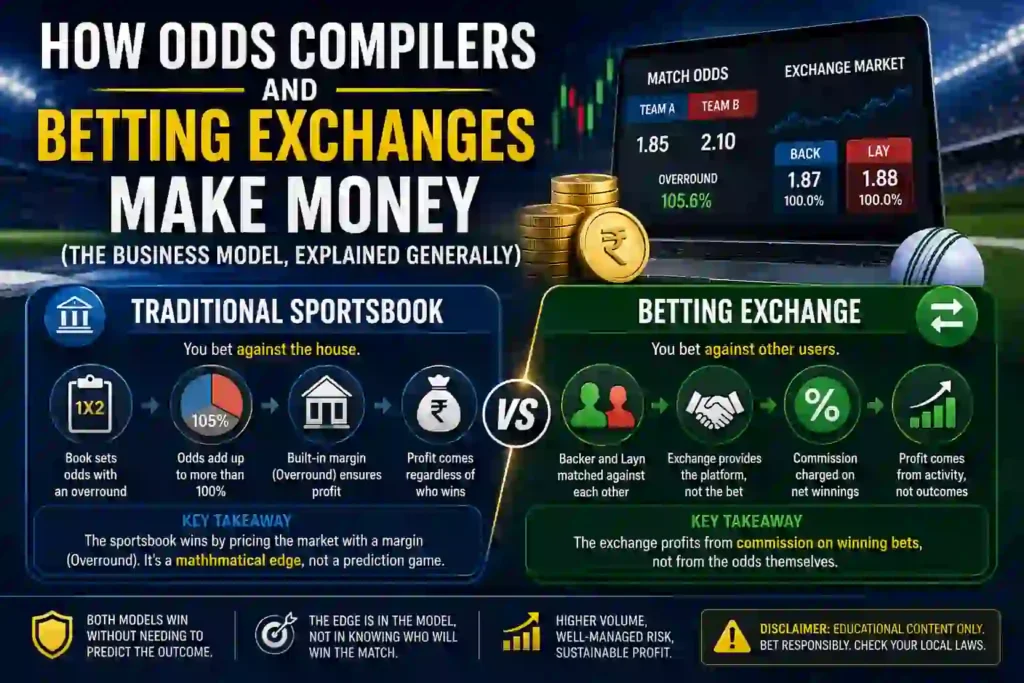
Sportsbooks and betting exchanges are businesses, and like any business, they need a reliable way to earn revenue regardless of who wins a match. This article explains — in general, platform-neutral terms — the actual mechanics behind how these two business models generate income: where the money really comes from, why it doesn’t depend on picking winners, and how the two dominant structures (the traditional sportsbook and the newer betting exchange) differ in how they capture their margin.
⚠ A note before we start: This article is educational only. It explains industry business models as a matter of general public interest — it is not an endorsement of any platform, product, or provider, and it isn’t advice to bet. The legality of sports betting varies by country and, in some countries, by state or region — check your local rules before acting on anything here. If betting ever stops feeling like entertainment and starts feeling compulsive, that’s worth taking seriously; support is available through organisations like GamCare, BeGambleAware, or a local problem-gambling helpline.
Table of Contents
- The Core Idea: Margin, Not Prediction
- How a Traditional Sportsbook Makes Money
- How a Betting Exchange Makes Money
- Sportsbook vs Exchange: Two Different Revenue Engines
- Risk Management: Balancing the Book
- Other Revenue Streams Beyond the Core Margin
- Worked Examples of Each Model
- Common Misconceptions About How These Businesses Work
- Frequently Asked Questions
1. The Core Idea: Margin, Not Prediction
It’s a common misconception that a betting operator makes money by being better than its customers at predicting match outcomes with their betting id. In reality, the core business model doesn’t depend on that at all. Both sportsbooks and exchanges build their revenue around a structural margin baked into the pricing itself — a mathematical edge that exists no matter who actually wins the match.
This margin is often called the overround (or “the vig,” “the juice,” or “the book’s edge”). It works the same way a currency exchange counter profits by offering a slightly worse rate than the true interbank rate — the profit is in the spread, not in correctly forecasting which currency will move where.
2. How a Traditional Sportsbook Makes Money
A traditional sportsbook (sometimes called a “bookmaker”) takes bets directly against its own customers. When you bet with a sportsbook, you’re betting against the house, not against other users.
The Overround in Practice
If a sportsbook priced a two-way market with genuinely fair odds, the implied probabilities of both outcomes would add up to exactly 100%. In practice, a sportsbook prices the market so the probabilities add up to slightly more — commonly 104% to 108% for a well-contested cricket match. That extra few percentage points is the built-in margin, and it’s collected regardless of the outcome, spread proportionally across both sides of the market.
Why It Doesn’t Matter Who Wins
As long as the sportsbook attracts a roughly balanced amount of money on each side of a market (relative to the priced probabilities), the overround guarantees a profit margin on the total handled volume — independent of which team actually wins. The sportsbook isn’t betting on the match itself; it’s running a pricing business with a structural edge, similar in spirit to how a casino’s house edge works on a roulette wheel.
3. How a Betting Exchange Makes Money
A betting exchange works completely differently. Instead of taking bets against the house, an exchange matches customers directly against each other — one person backing an outcome, another laying (betting against) that same outcome. The exchange itself never takes a market position; it simply provides the marketplace.
Commission on Net Winnings
Because the exchange isn’t a party to the bet, its revenue model looks completely different from a sportsbook’s. Instead of an overround baked into the price, an exchange typically charges a commission — a percentage taken from a user’s net winnings on a market, not from every bet placed. If a user loses, no commission applies to that market at all.
Why Exchange Prices Often Look “Better”
Because the exchange doesn’t need to build a large margin into every price the way a sportsbook does, exchange odds often reflect something closer to the “true” market-implied probability, with a much smaller overround than a comparable sportsbook market. The exchange still profits — just through commission on the winning side of matched bets, rather than through margin on every price.
4. Sportsbook vs Exchange: Two Different Revenue Engines
| Factor | Traditional Sportsbook | Betting Exchange |
|---|---|---|
| Who you bet against | The house | Other users |
| Main revenue source | Overround baked into odds | Commission on net winnings |
| Does the operator take a market position? | Yes | No |
| Typical price competitiveness | Lower (larger built-in margin) | Higher (smaller built-in margin) |
| Can you bet “against” an outcome directly? | Not directly — only by backing the alternative | Yes, by “laying” the outcome |
5. Risk Management: Balancing the Book
Both models rely heavily on risk management to protect their margin, though the mechanics differ.
A sportsbook manages risk by adjusting its prices as money flows in — if one side of a market attracts disproportionate action, the operator shifts the price to encourage more balanced betting on both sides, protecting its margin regardless of the eventual result. This is often described as “balancing the book.”
An exchange doesn’t need to balance a book in the same way, since it never takes a position — but it still needs enough liquidity (enough backers and layers on both sides of a market) for prices to be meaningful and bets to actually get matched. An illiquid exchange market, with too few participants, produces wide and unreliable prices — which is why exchanges actively work to attract high trading volume.
6. Other Revenue Streams Beyond the Core Margin
Beyond the core overround or commission model, operators in this space commonly generate additional revenue through several other channels:
- Premium or higher-limit accounts: some sportsbooks offer tiered account types with different limits and features.
- Data and streaming licensing: operators often license official live data feeds or streaming rights from sports federations, which represents a real operating cost, but some also monetise value-added data products to other businesses.
- Payment processing float: the short period between a deposit and a withdrawal can generate incidental interest income at scale, though this is typically a minor factor compared to the core margin.
- Advertising and sponsorship deals: some larger operators generate revenue by selling advertising space or brand sponsorships to other businesses, separate from the betting activity itself.
7. Worked Examples of Each Model
Sportsbook Example
A sportsbook prices a two-way cricket match at Team A 1.90 (implied probability 52.6%) and Team B 2.05 (implied probability 48.8%). Added together: 101.4% — a 1.4% overround. If the sportsbook receives roughly proportional betting volume on both sides, it locks in close to that 1.4% margin on the total money wagered, regardless of which team wins.
Exchange Example
On an exchange, a user backs Team A at 2.00 with a stake of ₹1,000, and another user lays Team A at the same price. If Team A wins, the backer wins ₹1,000 profit — but the exchange charges a commission (commonly around 2–5%, varying by platform) on that ₹1,000 net win, so the backer actually receives their profit minus that commission. If Team A loses, no commission applies to that market, since there was no net winning position to charge against.
8. Common Misconceptions About How These Businesses Work
- “The bookmaker wants a specific team to win.” In a well-balanced book, the operator’s margin is largely locked in regardless of outcome — the real objective is balanced volume on both sides, not a particular result.
- “Exchanges are basically the same as sportsbooks, just with a different name.” The underlying mechanics are fundamentally different — one takes a market position and prices in a margin, the other never takes a position and charges commission only on net winnings.
- “A lower overround means a platform is losing money.” A tighter margin doesn’t mean lower profitability — it usually reflects higher trading volume and stronger competitive positioning, which can be more profitable in aggregate than a wider margin on lower volume.
- “Commission-based models are always cheaper for the customer.” This depends on the specific commission rate and how it interacts with the price received — a low overround combined with a meaningful commission rate can, in some cases, end up costing a similar amount overall to a sportsbook’s built-in margin.
9. Frequently Asked Questions
Do sportsbooks lose money if a huge underdog wins?
It’s possible on an individual market if betting volume was heavily skewed toward the eventual winner, but well-managed sportsbooks price and adjust markets specifically to minimise this risk across their overall book, spreading exposure across many markets and events rather than depending on any single outcome.
Why do exchange commissions vary between platforms?
Commission rates are a direct lever on the exchange’s core revenue, so they vary based on competitive positioning, target trading volume, and sometimes a user’s own trading activity level, similar to how brokerage fees can vary by account tier in other trading contexts.
Is one business model inherently “fairer” than the other?
Not inherently — they’re just structurally different ways of capturing a margin. A sportsbook’s margin is embedded invisibly in the price; an exchange’s is a visible, separate commission line. Which one works out better for a given user in a given market depends on the specific odds and commission rate on offer, not on the model type alone.
What does “liquidity” mean on an exchange, and why does it matter?
Liquidity refers to how much money is actively available to back and lay a given market. High liquidity means bets are matched quickly at prices close to the displayed odds; low liquidity means wider effective prices and a higher chance a bet can only be partially matched.
Educational content on sports-betting business models. Not an endorsement of any platform or provider, and not betting advice. 18+ only where applicable. Check local laws before engaging in any betting-related activity.
