
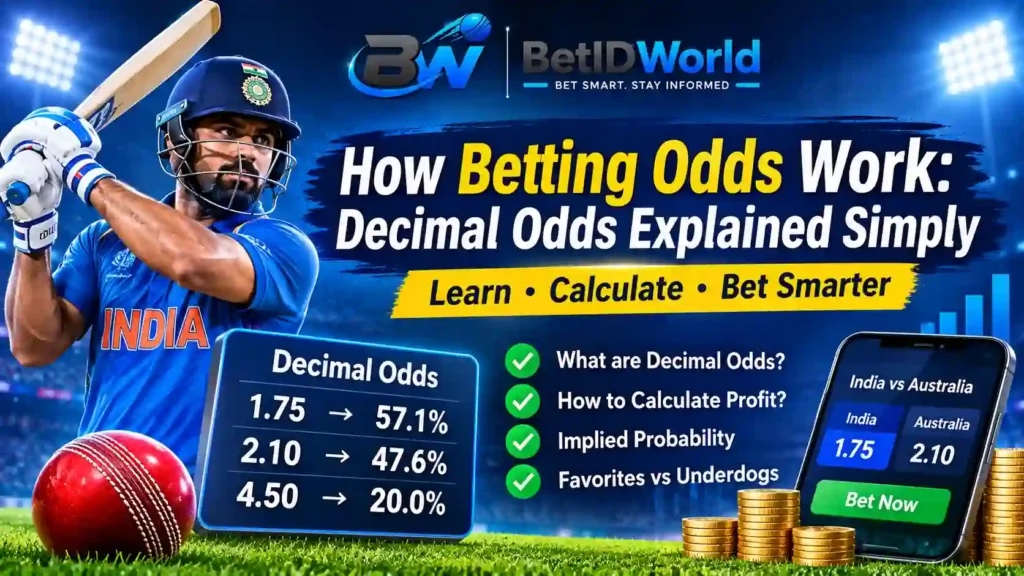
If you have ever looked at a cricket betting site and seen numbers like 1.75, 2.10, or 4.50 next to team names and wondered what they actually mean, this guide is for you. Understanding decimal odds takes about ten minutes, and once it clicks, every bet you place becomes a calculated decision instead of a guess. Whether you already have an online cricket id or you are just getting started with cricket betting, this article breaks down decimal odds in the simplest possible way, with real cricket examples, real math, and real money calculations you can verify yourself.
What Are Decimal Odds?
Decimal odds are the standard way of displaying betting prices on most platforms you access with an online cricket id, including cricket exchanges and bookmaker sites. A decimal odd is a single number that tells you exactly one thing: how much money you get back in total for every ₹1 you stake.
The number always includes your original stake. That is the single most important thing to remember in this entire article.
- Odds of 2.00 → you get back ₹2 for every ₹1 staked (₹1 profit + ₹1 stake)
- Odds of 1.50 → you get back ₹1.50 for every ₹1 staked (₹0.50 profit + ₹1 stake)
- Odds of 3.00 → you get back ₹3 for every ₹1 staked (₹2 profit + ₹1 stake)
That is the whole concept. Everything else in this guide is just applying this one idea to real situations.
The Two Formulas You Need to Memorize
Only two formulas matter with decimal odds. Write them down.
Formula 1: Total Return
Total Return = Stake × Decimal Odds
Formula 2: Profit
Profit = Stake × (Decimal Odds − 1)
Notice the “−1” in the profit formula. It removes your original stake so you can see your actual winnings. Let’s apply both formulas to a real example.
Real Example: India vs Australia T20 Match
Imagine a T20 match between India and Australia. The bookmaker offers these odds:
| Outcome | Decimal Odds | Implied Probability |
|---|---|---|
| India wins | 1.75 | 57.1% |
| Australia wins | 2.10 | 47.6% |
You believe India will win, so you stake ₹1,000 on India at 1.75.
- Total return = ₹1,000 × 1.75 = ₹1,750
- Profit = ₹1,000 × (1.75 − 1) = ₹1,000 × 0.75 = ₹750
- Your stake back = ₹1,000
So if India wins, your account balance increases by ₹1,750 — your original ₹1,000 plus ₹750 profit. If India loses, you lose your ₹1,000 stake. Simple.
How to Calculate Implied Probability from Decimal Odds
This is the most useful skill in betting. Decimal odds hide a percentage inside them — the bookmaker’s estimate of how likely an outcome is. The formula is:
Implied Probability = (1 ÷ Decimal Odds) × 100
Applied to our match:
- India at 1.75 → (1 ÷ 1.75) × 100 = 57.1%
- Australia at 2.10 → (1 ÷ 2.10) × 100 = 47.6%
Add those together and you get 104.7%. But a match can only have one winner — the true total should be 100%. The extra 4.7% is the bookmaker’s margin (also called the overround or vig). This is how bookmakers make money: they price every outcome slightly worse than its true probability.
Quick Reference: Decimal Odds, Profit and Probability Table
Bookmark this table. It covers the most common odds you will see in cricket betting.
| Decimal Odds | Profit on ₹100 Stake | Implied Probability | What It Usually Means |
|---|---|---|---|
| 1.10 | ₹10 | 90.9% | Extremely heavy favorite |
| 1.30 | ₹30 | 76.9% | Strong favorite |
| 1.50 | ₹50 | 66.7% | Clear favorite |
| 1.75 | ₹75 | 57.1% | Moderate favorite |
| 2.00 | ₹100 | 50% | Coin-flip (evens) |
| 2.50 | ₹150 | 40% | Slight underdog |
| 3.00 | ₹200 | 33.3% | Underdog |
| 5.00 | ₹400 | 20% | Big underdog |
| 10.00 | ₹900 | 10% | Outsider / long shot |
Favorites and Underdogs: How to Spot Them Instantly
You do not need anyone to tell you which team is favored. The number does it for you:
- Odds below 2.00 → the team is the favorite. The lower the number, the stronger the favorite. Odds of 1.20 mean the market expects this outcome roughly 83% of the time.
- Odds above 2.00 → the team is the underdog. The higher the number, the bigger the upset needs to be — but the bigger your profit if it happens.
- Odds of exactly 2.00 → the market considers it a genuine 50-50 (a “coin flip”).
A quick shortcut for favorites: subtract 1 from the odds to see the profit per rupee. A team at 1.40 pays ₹0.40 profit per ₹1. A team at 1.05 pays only ₹0.05 per ₹1 — that is how certain the market thinks the result is.
Why Do Odds Change Before a Match?
Odds are not fixed in stone. They move constantly from the moment markets open until the first ball is bowled. The main reasons are:
- Team news — if the captain confirms Virat Kohli is rested, India’s odds might drift from 1.75 to 1.95. If Jasprit Bumrah is declared fit, they might shorten to 1.60.
- Pitch and weather reports — a green, seaming pitch favors bowlers; a dry turning track favors spinners. Dew forecasts heavily influence the toss and chase odds.
- Where the money goes — bookmakers adjust prices to balance their books. Heavy betting on one side forces the odds on that side down and the other side up.
- In-play events — once the match starts, odds react ball by ball. A wicket in the first over can move odds dramatically within seconds.
This is why two bettors holding the same online cricket id can see different prices minutes apart — one bet at 1.80 before the toss, another at 1.65 after it. Learning to read why odds move is a skill that separates informed bettors from casual ones.
Decimal Odds on Betting Exchanges: Back and Lay
On a betting exchange (peer-to-peer betting), decimal odds work the same way, but you can take either side of the bet:
- Back bet — you bet something WILL happen, exactly like a normal bet. Backing India at 2.00 with ₹500 returns ₹1,000 if India wins.
- Lay bet — you bet something will NOT happen. You act as the bookmaker. Laying India at 2.00 means you accept a ₹500 backer’s stake; if India loses, you win ₹500, but if India wins, you pay out ₹500.
On exchanges, you will also see commission — typically 2% to 5% charged on net winnings only, not on your stake or losing bets. So if you back India at 2.00 with ₹500 and win, your profit is ₹500, and at 3% commission you keep ₹485.
Decimal vs Fractional vs American Odds
You will occasionally see other odds formats. Here is how to convert them mentally:
| Decimal | Fractional (UK) | American (US) | Profit on ₹100 |
|---|---|---|---|
| 1.50 | 1/2 | -200 | ₹50 |
| 1.85 | 17/20 | -118 | ₹85 |
| 2.00 | 1/1 (evens) | +100 | ₹100 |
| 2.50 | 6/4 | +150 | ₹150 |
| 3.00 | 2/1 | +200 | ₹200 |
Decimal is by far the easiest format for calculations, which is why it dominates cricket exchanges and most platforms where you use your online cricket id.
Five Mistakes Beginners Make with Decimal Odds
- Forgetting that odds include the stake. Betting ₹500 at 1.80 does not return ₹900 profit — it returns ₹900 total (₹400 profit + ₹500 stake). Always subtract 1 when calculating profit.
- Confusing low odds with “safe” bets. A 1.10 favorite still loses roughly 1 time in 10. Chasing tiny odds with big stakes is one of the fastest ways to blow a bankroll.
- Ignoring the bookmaker’s margin. If both sides of a coin-flip are priced at 1.90 instead of 2.00, you are paying a 5.3% margin. Over hundreds of bets, that margin grinds you down.
- Not comparing odds across platforms. India at 1.85 on one platform and 1.95 on another is a real difference. On a ₹5,000 stake, that is ₹500 extra profit for the same bet. Professional bettors always shop for the best price.
- Betting on high odds out of greed. A 10.00 shot wins about 10% of the time. Long shots are entertainment, not a strategy.
How to Compare Odds Like a Professional
Here is a practical habit that costs nothing and instantly improves your results: before every bet, check the same market on at least two platforms. Let’s say you want to back England in a T20 match:
- Platform A: England at 1.85 → ₹1,000 returns ₹1,850
- Platform B: England at 1.95 → ₹1,000 returns ₹1,950
Same match, same team, same risk — but ₹100 more in your pocket simply for checking. This is called odds shopping, and over a season of IPL betting it can easily add up to more than your entire starting bankroll.
Frequently Asked Questions
What does an online cricket id have to do with reading odds?
Your online cricket id is the account you use to log in and place bets, but the odds are the same numbers shown on every platform. Understanding decimal odds means you can evaluate any market on any platform the moment you log in with your cricket id — no extra tools needed.
Are lower or higher decimal odds better?
Neither is “better” — they represent different things. Lower odds mean a higher probability of winning but smaller profits. Higher odds mean lower probability but bigger profits. Good betting is about finding odds where you believe the true chance is higher than the implied probability suggests.
What do odds of 1.01 mean?
A profit of just 1% on your stake. The market considers this outcome almost certain (99% implied probability). These bets win often but pay almost nothing — one loss wipes out the profit of roughly 100 winning bets.
Can decimal odds be below 1.00?
No. Odds below 1.00 would mean you get back less than you staked even when you win, which is not how betting works.
How do I convert decimal odds to probability in my head?
Divide 100 by the decimal number. Odds of 4.00 → 100 ÷ 4 = 25%. Odds of 1.25 → 100 ÷ 1.25 = 80%. It takes two seconds.
Why do odds add up to more than 100%?
That extra percentage is the bookmaker’s margin — their built-in profit on the market. A total of 104% to 107% is normal; anything above 110% suggests poor value.
The Bottom Line
Decimal odds tell you three things at once: your total return (stake × odds), your profit (stake × odds − 1), and the implied probability (100 ÷ odds). Once you can read all three instantly, you stop betting blindly and start making informed, value-based decisions with your online cricket id. Combine that skill with comparing odds across platforms, understanding why odds move, and managing your bankroll with discipline — and you will already be ahead of most casual bettors.
Remember: betting should always be treated as entertainment, never as income. Set a budget you can afford to lose, never chase losses, and take breaks. If you or someone you know needs support with gambling habits, please seek help from a professional counselling service.
