
Introduction
Online betting is one of the most talked-about — and most misunderstood — corners of the internet in India. Between viral ads during cricket matches, “betting ID” offers circulating on social media, and a legal landscape that has changed dramatically in the last year, it’s genuinely hard for an ordinary reader to know what’s true, what’s legal, and what’s safe.
This guide exists to cut through that confusion. It doesn’t recommend, endorse, or link to any betting operator, agent, or “ID provider.” Its only goal is to explain, in plain language, how online betting works, what the law in India actually says as of 2026, and how to think about risk if you ever encounter this world — whether out of curiosity, research, or concern for someone else.
Part 1: The Basics — What Online Betting Actually Is
At its core, online betting means placing a wager on the outcome of an event — a cricket match, a football game, a casino card game, a virtual race — through a website or app, with real money at stake.
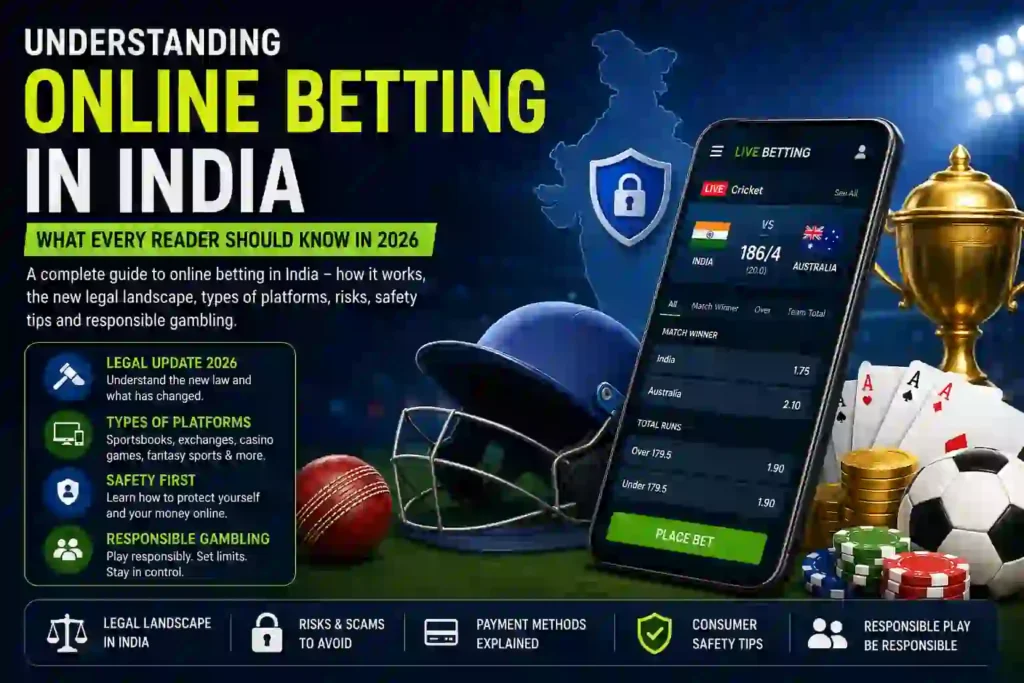
Broadly, platforms fall into a few categories:
- Sportsbooks — you bet against the operator, who sets the odds. Cricket, football, and tennis are the most common markets in India.
- Betting exchanges — you bet against other users, not the house, and the platform takes a commission.
- Casino-style platforms — roulette, blackjack, slots, and live-dealer games, where outcomes are governed by chance.
- Fantasy sports — users build virtual teams from real players and win based on real-world statistical performance. Indian courts have historically treated well-structured fantasy formats differently from betting, though this distinction is now being tested by new legislation (more below).
None of these categories is inherently mysterious — they’re just different structures for the same basic idea: money changes hands based on an uncertain outcome.
Part 2: The Legal Landscape in India Has Changed — Significantly
This is the single most important update for anyone researching betting in India right now, and it’s recent enough that a lot of older articles online are out of date.
The old system
For decades, gambling regulation in India sat mostly with individual states, under a colonial-era law, the Public Gambling Act, 1867, and various state amendments. Courts developed a “skill vs. chance” test: games where skill predominated (rummy, fantasy sports, horse racing) were generally treated as legal; pure games of chance were not. This created a patchwork — legal in some states, restricted in others, and largely silent on offshore websites.
The new law: Promotion and Regulation of Online Gaming Act, 2025
In August 2025, Parliament passed the Promotion and Regulation of Online Gaming Act, 2025, followed by detailed Rules in 2026 that brought the framework fully into force. This law is a major departure from the old skill-vs-chance approach. Key points:
- It creates one national framework instead of leaving betting/gambling law to individual states.
- It sorts all online games into three buckets:
- Online money games — any game, whether skill-based, chance-based, or both, played by depositing money with an expectation of winning money or something of value. This category is banned outright — including sports betting, betting exchanges, online casino games, and even previously “legal” real-money formats like rummy, poker, and fantasy sports.
- E-sports — competitive multiplayer games where the outcome depends purely on skill, with no wagering allowed, and which must be registered with a new regulator.
- Online social games — casual or recreational games that can charge a subscription or access fee, but cannot involve staking money for a chance to win more money.
- A new central regulator, the Online Gaming Authority, oversees registration, classification, and enforcement.
- The law explicitly applies to offshore platforms that serve Indian users, not just companies based in India — closing the old loophole where a foreign-hosted site was seen as outside India’s reach.
- Penalties are serious: offering or facilitating an online money game can carry imprisonment (commonly cited as up to 3 years, rising to a minimum of 3 years and up to 5 for repeat offences) plus fines that can run into crores of rupees. Advertising a banned platform is also punishable. Banks and payment processors that knowingly facilitate transactions for such platforms face their own penalties.
- Enforcement so far has focused on operators, advertisers, and financial facilitators rather than individual players, but the legal exposure for platforms — and the practical risk to users’ money — is real and growing.
What this means in practice
- Domestic real-money betting and gambling platforms have shut down or gone fully free-to-play. Several major Indian gaming companies withdrew their real-money products after the ban.
- Offshore betting sites have not disappeared — usage has reportedly increased, as displaced users move to unregulated foreign platforms accessed via mirror websites, VPNs, or third-party “ID” resellers. Independent surveys after the ban found offshore platform usage among Indian users rose rather than fell.
- The government has continued blocking thousands of illegal betting and gambling websites and apps (well over 7,800 by early 2026), but operators frequently reappear under new domain names, a pattern often called “URL switching.”
- Courts are still actively hearing constitutional challenges to the new law, so some details may continue to evolve.
The practical takeaway: as of 2026, real-money sports betting, casino gaming, and similar “money games” are prohibited nationwide in India, regardless of which state you’re in, and regardless of whether the platform is based in India or abroad. This is a genuinely different legal reality from just a couple of years ago, and it’s worth knowing before treating any “betting ID,” agent, or offshore platform as a normal consumer service.
Part 3: “Betting ID” Services — What They Are and Why Extra Caution Applies
You may have come across websites or social media pages offering to sell you an “online betting ID” or “cricket ID” — a login credential that supposedly gives you access to an offshore betting or casino platform, often bundled with claims of instant activation, fast withdrawals, and round-the-clock support.
A few things are worth understanding about this specific category:
- These services are intermediaries, not the platforms themselves. You’re generally trusting a third party — often anonymous or difficult to verify — with your money and personal details, on top of trusting the offshore platform they connect you to.
- They sit squarely inside the activity the 2025–26 law targets. Facilitating access to, or financially routing money toward, an online money game aimed at Indian users is exactly what the Act criminalises for operators and facilitators.
- Recourse is limited if something goes wrong. If an ID reseller disappears with a deposit, or a linked offshore platform refuses a withdrawal, there is generally no regulator, ombudsman, or court in India that will resolve the dispute in your favour, because the underlying activity isn’t a recognised, licensed service.
- Enforcement agencies have flagged links between illegal betting platforms and money-laundering patterns — including “mule” bank accounts used to move funds out of the country. Users transacting through such channels can find their own bank accounts scrutinised or frozen, even if their intent was simply to place a bet.
None of this is a judgment on anyone who has used such a service — it’s simply the factual risk picture, which is often left out of promotional material.
Part 4: How to Evaluate Any Platform — General Consumer Literacy
Whether you’re researching this space for curiosity, journalism, policy interest, or because you’re based somewhere betting is legally regulated, the same basic consumer-protection questions apply:
Transparency
- Is the operator clearly identified, with a real corporate name, licensing body, and jurisdiction?
- Are Terms & Conditions, a Privacy Policy, and a Responsible Gambling policy easy to find and clearly written?
Security
- Does the site use HTTPS encryption? (Necessary, but not sufficient — a scam site can also have a padlock icon.)
- Is two-factor authentication available?
- Are there clear procedures for identity verification, and do they explain why documents are requested?
Payments
- Are fees, processing times, and withdrawal limits disclosed up front, not just deposit bonuses?
- Is there a traceable, named payment provider, rather than instructions to pay an individual’s personal account or wallet?
Support and dispute resolution
- Are there multiple, responsive support channels?
- Is there a clear complaints or dispute process, and — critically — is there any external regulator who could actually enforce a resolution?
Regulatory status
- Is the platform licensed anywhere, and does that license actually cover the activity and the user’s location?
- Is the activity itself legal in the user’s jurisdiction? (As covered above, for India in 2026, this is the threshold question for real-money betting.)
Part 5: Responsible Gambling — Wherever It Is Legal
Where betting or gambling is legally available (for instance, licensed platforms in permitted jurisdictions, or regulated formats like state-run lotteries), it should be treated as entertainment with a real cost, never as an income strategy. Widely recommended practices include:
- Setting a strict time and spending limit before starting, and not adjusting it upward mid-session.
- Never “chasing losses” — increasing bets to try to recover money already lost.
- Avoiding gambling while emotionally distressed, intoxicated, or under significant financial pressure.
- Taking regular breaks and treating any single session as a fixed, sunk cost, win or lose.
- Using self-exclusion or deposit-limit tools where platforms offer them.
- Seeking support early if gambling starts to feel difficult to control — this is a recognised pattern, not a personal failing, and professional help exists specifically for it.
Frequently Asked Questions
Is all online betting illegal in India now? Since the Promotion and Regulation of Online Gaming Act, 2025 and its 2026 Rules came into force, “online money games” — a category that includes sports betting, betting exchanges, online casino games, and real-money fantasy sports, rummy, and poker — are prohibited nationwide, regardless of the state or whether the platform is based in India or abroad.
Does using a VPN make offshore betting legal? No. A VPN can hide your location technically, but it does not change the legal status of the underlying activity, and it doesn’t reduce the financial and dispute-resolution risks described above.
Are “betting ID” providers legal or safe? They occupy exactly the space the current law is aimed at — facilitating access to and payment for online money games. Independent of the legal question, using an unverified third party to hold your login and route your money to an offshore platform carries meaningful financial and privacy risk with little practical recourse if something goes wrong.
Is fantasy sports the same as betting? For years, Indian courts distinguished well-structured fantasy sports as a “game of skill.” The 2025 Act’s definition of “online money game” is broad enough to capture any real-money format regardless of skill or chance, which is why several major fantasy platforms suspended real-money formats in India after the law came into force. This is still an active area of legal challenge.
What should I do if I’m worried about my own or someone else’s gambling? Treat it as you would any other pattern that’s becoming hard to control: talk to a doctor, counsellor, or a dedicated problem-gambling support service, and consider using bank-level or platform-level blocking tools where available.
Key Takeaways
- India’s legal framework for online betting changed fundamentally in 2025–2026: real-money betting and gambling of nearly every kind is now prohibited nationwide, including on offshore sites.
- “Betting ID” and similar reseller services sit inside the activity the new law specifically targets, and carry real financial and privacy risk beyond the legal question.
- Basic consumer-literacy questions — transparency, security, payment clarity, dispute resolution, and actual legal status — apply to any platform, anywhere.
- If betting or gambling is ever part of your life where it is legally available, responsible-gambling habits and awareness of your own patterns matter more than any platform feature.
This guide is for general information only and is not legal advice. Laws referenced here are subject to ongoing court challenges and regulatory updates; readers should check current official sources for the latest status.
